How to Register a Delayed Death in India: 21 Days, 30 Days, 1 Year and 2 Years
A death can still be registered after the normal 21-day period. The documents and authority depend on how long the event went unreported. This guide explains Section 13 of the Registration of Births and Deaths Act, including the rules effective from 1 October 2026.
On this page
Can a death be registered after 21 days?
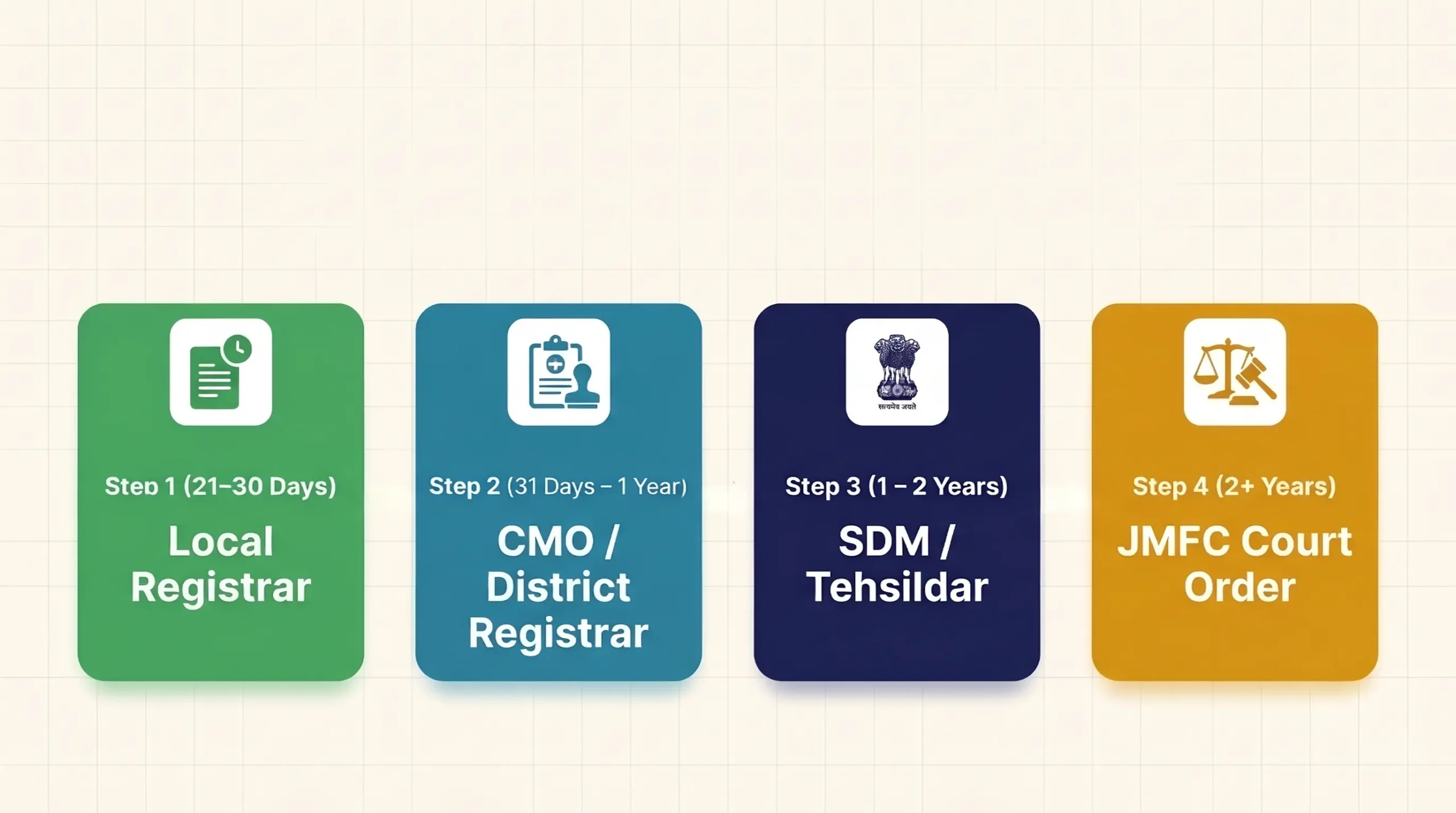
Yes. Deaths are normally reported within 21 days. Under Section 13 of the Registration of Births and Deaths Act, late reporting is possible: 22–30 days requires a late fee; after 30 days up to one year requires written permission and a prescribed self-attested document; after one year up to two years requires an executive-authority order; after two years requires a JMFC order. First check whether the event was already registered.
Start with the registration record
Process illustration, not an official decision of a Registrar. Form 10 documents a search with no matching entry; it does not prove that the death occurred.
Legal time bands are based on when information is given to the Registrar, not merely when the family first realised the certificate was missing. Rules on supporting evidence and fees can differ by state. Sources [1–4].
The five time limits under Section 13
| Delay | Authority / provision | What the law requires |
|---|---|---|
| Within 21 days | Local Registrar · Sections 8, 10 | Report the event through the relevant registration unit. No late-registration fee. |
| After 21 and within 30 days | Local Registrar · Section 13(1) | Submit death information with the prescribed late fee. |
| After 30 days and within 1 year | District Registrar or authorised authority · Section 13(2) | Written permission, prescribed fee and a self-attested document in the form required locally. |
| After 1 year and within 2 years | DM, SDM or DM-authorised Executive Magistrate · Section 13(3) | Order after verification of the event, and prescribed fee. |
| After 2 years | Judicial Magistrate of the First Class · Section 13(3A) | JMFC order after verification of the death, and prescribed fee. |
The 2023 version of Section 13(3) already used the executive-magistrate route for cases reported more than one year after the event.
The 2026 amendment retained the executive route for one-to-two-year delays and introduced a separate Section 13(3A) judicial route for delays exceeding two years.
“District Registrar” and “CMO” are not interchangeable everywhere. A Chief Medical Officer, District Health Officer or municipal health official handles the approval only where that officer is the District Registrar or has the relevant delegated authority under applicable rules. Confirm the designated officer with the local registration unit rather than assuming that every case needs CMO permission.
Find the next step for your case
Select the time since death and where it occurred. This shows the central statutory route; it does not submit an application or determine your state's complete document list.
Written permission from the District Registrar or authorised authority
Find the jurisdictional Registrar, check existing records, gather Form 2 and proof, and use the prescribed self-attested declaration.
Where to apply: home death versus hospital death
Local death registrar
Under Section 8, the head of household or other designated informant ordinarily reports the event. Approach the Gram Panchayat, municipality or local registration unit for the place of death. Provide Form 2 and available evidence. Form 4A may apply when a medical practitioner attended the deceased during the last illness and can certify the cause.
Check the hospital report first
Under Section 8, the medical officer in charge or authorised person has the reporting duty. Ask medical records for the death report, Form 4 where applicable, the date sent to the Registrar and any acknowledgement or registration number. Do not submit a second home-death report for a hospital death.
Step-by-step process
Registration is ordinarily at the place of occurrence, even if the family now lives in another state. In a city, identify the municipal/cantonment/local-body registrar; in a village, the designated rural registrar.
Provide the deceased's name, date and place of death. If an entry exists, obtain the extract. If it does not, ask whether a Non-Availability Certificate is needed.
Obtain Form 2, hospital/medical documents or available contemporaneous records, applicant identification and the prescribed declaration or other evidence requested by the registrar.
Use the relevant authority for the delay band. A longer-delay file may undergo local, revenue or other verification before an order is issued.
Pay the prescribed registration fee, provide any missing particulars and confirm that a death-register entry is created.
Verify name, date, place, registration number and other recorded particulars. Correct errors using the formal correction route rather than submitting duplicate registration.
What happens after an application needs a magistrate's order?
Executive-authority route
- Contact the Registrar and confirm whether a death entry already exists.
- Prepare available proof of date and place of death, the application and any requested register-search record.
- Apply to the DM, SDM or DM-authorised Executive Magistrate having jurisdiction.
- The authority verifies correctness; this may involve local records or an inquiry where necessary.
- Submit the order and prescribed fee to the Registrar for the death entry and certificate.
Judicial Magistrate First Class route
- Ask the Registrar for a record search and the court's current evidence checklist.
- Apply to the jurisdictional JMFC under the applicable local filing procedure.
- Produce available medical, funeral and identity records and any witnesses or declarations the court requires.
- The court verifies the event and decides whether to issue an order.
- Take the issued order to the Registrar and pay the prescribed registration fee.
How many working days will it take? No single nationwide service deadline covers all late-registration approvals and court proceedings. Processing depends on the state service charter, whether the records are already available, the required inquiry and, for judicial cases, the court. Request a written acknowledgement and the current local expected timeline; do not plan around an unsourced 7-, 21- or 90-day estimate.
Documents, Form 2, Form 4A and the NAC
What Form 2 and Form 10 identify
Form 2 — Death Report
Reference diagram only; use the prescribed government form, completed by the responsible informant.
Form 10 — Non-Availability Certificate
Reference diagram only; the authorised Registrar issues the actual certificate after a record search.
See the official Delhi 2024 amended rules (including Form 10) and Coimbatore Municipal Corporation's form guide for government examples. These illustrations do not reproduce or replace an application form.
The following checklist covers commonly relevant evidence. It is not a universal mandatory list; state rules and the facts of the death determine what is accepted.
Prepare what is available 0 selected
Death Report
Contains information used to record the death. It is different from a hospital cause-of-death certificate and from the final certificate issued after registration.
Medical cause-of-death certification
Form 4 applies to relevant hospital in-patient deaths; Form 4A concerns non-institutional deaths when a medical practitioner attended the person during their last illness. Not every family can independently obtain Form 4A after an unattended home death.
Non-Availability Certificate
Request a search of the relevant death register under Section 17. If the event is not found, the Registrar can issue a non-availability certificate. It does not prove that death occurred; it establishes that no entry was found in the searched records.
Self-attested declaration
The central Act no longer makes a notarised affidavit mandatory for 30 days–one year. States may prescribe a declaration format; Rajasthan's amended rules, for example, contain Form 14. Ask for the current local prescribed format.
Sample self-attested declaration — 31 days to 1 year
Use your state’s prescribed document where available (for example, Rajasthan’s Form 14). This example avoids demanding an Aadhaar number or making an unverified claim that no register anywhere in India contains the death.
What if there is no medical Form 4A or cremation receipt?
Do I need a notary affidavit or a lawyer?
What can I write in the application?
State the deceased's full name, known date and place of death, applicant's relationship to the deceased, relevant documentary evidence, and a brief truthful reason the event was not reported in time. Request registration under Section 13 in accordance with the applicable period and local requirements. Attach the officially prescribed declaration or court papers, where applicable.
Do not copy an affidavit template that describes a false cause of death, asserts a nationwide non-registration search you have not performed, or invents a witness.
Official forms: Official form guide — Coimbatore Municipal Corporation · Rajasthan's 2025 Form 14.
State-wise official registration resources
Select the state or union territory where the death happened. The links below lead to government registration portals or official government guidance. A portal being listed does not mean every delayed or magistrate-order application can be completed entirely online.
36 entries
Verified examples of actual state differences
Its published CRS FAQ shows late fees of ₹100, ₹200 and ₹500 for successive delay bands, but its older “after one year” magistrate guidance predates the 2026 split. Confirm the current court route locally. TN CRS FAQ.
Its 2025 amended rules contain a prescribed self-attested declaration, Form 14, for Section 13(2). Pehchan is the state registration platform. State rules.
Janma-Mrityu Tathya provides a distinct online “Delayed Death Registration” service and a state notification explains which events are reported to hospitals or local bodies. Official service.
Kerala's LSGD explains its local-government registration system, and a panchayat notice specifically recognises the new one-to-two-year and over-two-year authorities from October 2026. 2026 notice.
Different local bodies—MCD, NDMC and Delhi Cantonment Board—maintain registration units. Delhi Revenue pages describe verification for delayed entries, but older checklists must be read alongside the 2026 Act. Chief Registrar resources.
Nagaland: the Department of Economics & Statistics publishes civil-registration notices and historical procedures. These must be read with the central amendments now in force. Nagaland department
The revamped central CRS portal publishes its participating jurisdictions. For Karnataka, Odisha, Kerala, Tamil Nadu, Rajasthan, West Bengal, Punjab and parts of Delhi, the linked local government resource is usually the better first route. CRS coverage notice.
Situations needing different checks
Three other situations that change the first step
Certificate absent online ≠ death unregistered
Ask for a manual-register search before starting delayed registration. Tamil Nadu's official CRS website, for example, directs pre-2018 certificate enquiries to the relevant local bodies. Digitising an existing entry is different from recording a new event.
No Aadhaar card?
Section 13 does not impose a universal requirement that every deceased person have Aadhaar. Ask for the state’s accepted identity and relationship evidence. Do not alter old records or invent an Aadhaar number.
Stillbirth versus live birth followed by death
Use Form 3 for a stillbirth. If a baby was born alive and later died, separate live-birth and death events ordinarily require Form 1 and Form 2. Medical classification and applicable reporting rules govern the forms.
Police and postmortem records
If an FIR, inquest or postmortem was involved, obtain the available police or medical records and ask the Registrar what verification is required. A funeral receipt alone may not settle the date or cause of death.
Not an ordinary delayed home death
Section 111 of the Bharatiya Sakshya Adhiniyam concerns the burden of proving that a person unheard of for seven years is alive. It does not itself establish the exact date or place of death. Seek the relevant civil declaration and Registrar's guidance; do not invent a date to use Form 2.
Consular records
A death occurring abroad is not registered anew as an event occurring within India. Section 20 recognises information recorded through the Indian consular system. Obtain the appropriate foreign or consular death documents; do not use the local Indian Section 13 route as though the death occurred at home in India.
Correction—not duplicate filing
If the event is in the register but the certificate has an error, ask for correction under Section 15 and relevant state rules. Section 13 is for delayed reporting, not a way to rewrite an existing death entry.
Questions families regularly ask
Can I register a death after five or ten years?
Can a CMO approve a death registered six months late?
Does every delayed application need an affidavit?
Is Form 10 mandatory before every magistrate application?
Can I register a death in my current city if it happened elsewhere?
Do late fees cost the same in every state?
Can a cremation receipt replace Form 4 or Form 4A?
Does the family have to hire a lawyer after two years?
What if the hospital never sent the death report?
Official legal sources and government forms
The materials below support the national deadlines, legal authorisation and document distinctions. State-specific sources are linked inside the directory above.
- India Code — Registration of Births and Deaths Act, 1969 (Sections 8, 10, 12, 13, 15, 17, 20 and 30).
- Gazette of India — Amendment Act 12 of 2026 (new Section 13(3A)).
- Gazette of India — S.O. 5081(E), 16 September 2026 (commencement on 1 October 2026).
- 2023 RBD Amendment Act (self-attested Section 13(2) documentation; verify latest composite text).
- Official form guide — Coimbatore Municipal Corporation (Form 2, Form 4, Form 4A, Form 10).
- ORGI revamped Civil Registration System (coverage and access).
- Rajasthan 2025 amended rules (example of Form 14 declaration and prescribed state procedure).
- Tamil Nadu CRS FAQ (state fee examples; older court directions should not override 2026 central law).
- Kerala local-government notice on the 2026 change.
- Bharatiya Sakshya Adhiniyam, 2023 — Section 111 (persons not heard of for seven years).
- Delhi Gazette — registration rules and specimen Form 10 (official example of prescribed NAC format).
- Tamil Nadu CRS — guidance for records before 2018
Verified as of 25 October 2026. This article explains the national statutory route. Local document lists, fees and filing steps may change through state notifications or court directions. In complicated cases, the appropriate Registrar or a qualified legal professional should check the specific file.
Identify the place-of-death registration unit, confirm whether an entry already exists, and ask the designated officer for the current Section 13 checklist. This usually avoids a second journey with the wrong affidavit or outdated magistrate form.
