Electric vs. LPG/CNG vs. Traditional Wood Cremation
How heat is produced, what different systems release into the environment, and which Hindu funeral rites can be performed. A practical comparison for families in India.
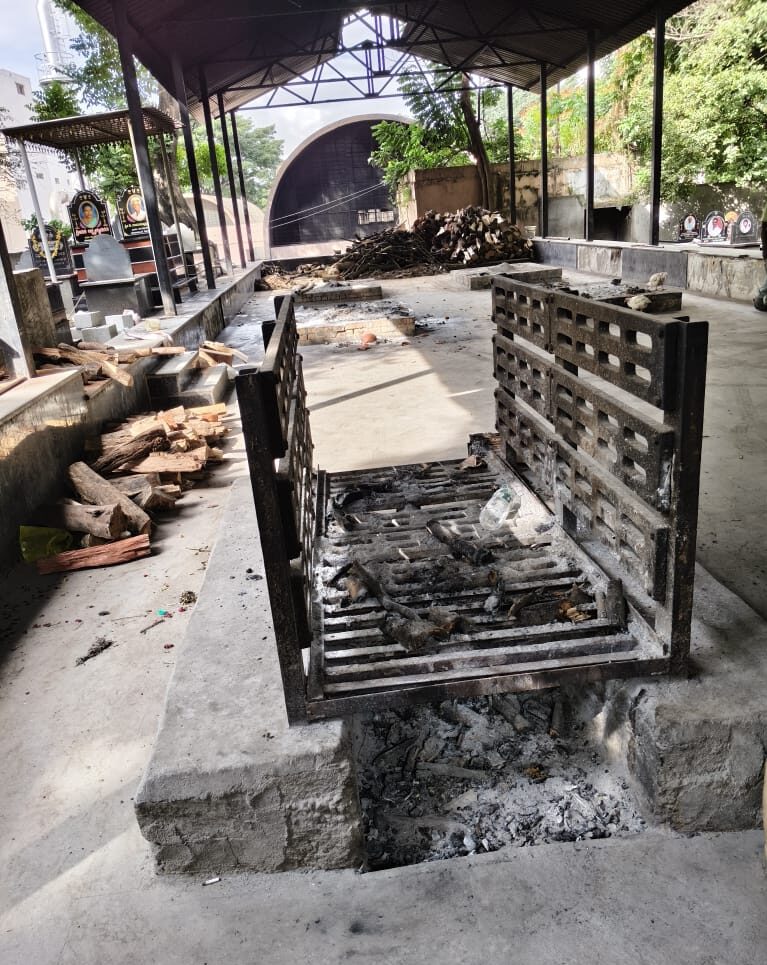

— each with different requirements
Four ways to generate heat.
Different consequences.
The source of heat changes the engineering and fuel supply. Furnace design, exhaust treatment, operating condition and family custom determine much of the rest.
Electric cremation uses electrical heating to raise the temperature inside an enclosed chamber. LPG and natural-gas cremation use fuel-fired burners. A traditional wood cremation takes place on an open pyre; improved-wood systems seek to reduce fuel use or improve airflow. All methods involve thermal breakdown of the body and recovery of cremated bone remains. No method can be ranked as universally fastest, cleanest or most appropriate without specifying the facility and the measure being compared.
Electric furnace
No primary fuel burner in a purely resistance-heated chamber. Electricity production still has an environmental footprint.
LPG furnace
Burners consume a propane-and-butane-rich fuel held as a pressurised liquid.
CNG / PNG furnace
Methane-rich natural gas arrives from a high-pressure cascade or a regulated pipeline.
Wood pyre
Logs burn around the body. An improved platform may change the airflow, fuel requirement and smoke pathway.
Inside the cremation system
Select a method. The schematic and the engineering explanation update together. These are conceptual diagrams, not drawings of a specific crematorium.
Not to scale. Real furnaces vary in chamber design, burners, exhaust treatment and operating controls.
Electric resistance cremation
Electrical resistance elements heat an insulated chamber. Forced air supports combustion of organic material within it; the absence of a fuel burner does not mean the process produces no exhaust.
| Question | Electric | LPG / CNG | Wood / improved wood |
|---|---|---|---|
| Where heat comes from | Heating elements | Fuel burners | Burning wood |
| Is a primary fuel flame required? | No, in purely electric units | Yes | Yes |
| What affects emissions? | Grid mix, chamber process, treatment | Fuel, burner tuning, treatment, leakage upstream | Moisture, fire conditions, wood source, hood/treatment |
| Can the family physically light the fuel? | Not a wood pyre; initiation rites may be adapted | Burner controls remain with operator | Pyre lighting is customary where permitted |
| Key booking uncertainty | Equipment and power status | Gas supply and furnace status | Wood, platform and permission to perform rites |
What heat actually does
The chemistry is more complicated than “the body becomes ash”. Several processes overlap and change with the heating rate, air supply, body characteristics and equipment.
Water is heated and removed
Moisture requires energy to heat and evaporate. This happens alongside the warming and breakdown of other tissues, not as a completely separate first step.
Organic material decomposes and burns
Heat breaks down organic compounds. When sufficient oxygen is available, some resulting gases and material combust; oxygen-poor regions may leave char.
Bone mineral is altered
Heat changes the mineral and structure of bone. The recovered cremated remains consist principally of mineral bone fragments, often processed after cooling.
Three ways heat moves
Radiation: hot walls, embers and flames transfer energy without needing physical contact.
Convection: flowing hot gases carry heat through the chamber or above a pyre.
Conduction: contacting solids transfer heat across surfaces and within materials.
All three can operate in every system. The proportions differ by design.
LPG is not the same as CNG.
Both power gas-fired furnaces. The fuel chemistry and supply arrangements are different. PNG and CNG are ways of delivering natural gas, not separate basic combustion chemistries.
Liquid storage, gas burner
LPG is predominantly propane and butane. It is stored as a pressurised liquid and supplied to a burner as vapour; some installations require a vaporiser and suitable cylinder or bulk storage arrangement.
Compressed natural gas
CNG is methane-rich natural gas held under high pressure. A cremator needs appropriate pressure regulation before the gas reaches its burners.
Gas through a pipeline
PNG is natural gas delivered through a distribution network and pressure controls. Availability depends on the connected local gas network and the crematorium installation.
Fuel CO₂ intensity is not the same as a cremation footprint
Illustrative direct combustion factors, per unit of fuel energy. Actual emissions per cremation also depend on how much fuel is burned, the equipment and upstream impacts.
Why a hood and cradle can change the process
Traditional pyres lose substantial heat to the surroundings. Improved-wood designs may use an elevated support, more organised air entry, a hood or a flue. These changes can reduce fuel consumption under appropriate operating conditions, but results are design- and site-dependent.
The label “improved wood” covers different implementations. A hood does not automatically mean effective particulate filtration.
Less smoke is not the same as less carbon.
To compare environmental performance, first decide which outcome matters: air breathed near the facility, greenhouse gases across the supply chain, or resource and water impacts.
Local air quality
Particulate matter, carbon monoxide, volatile compounds and other pollutants may be emitted at the site. A well-operated enclosed system with effective exhaust treatment can reduce nearby exposure, but the performance must be verified.
Life-cycle footprint
An assessment may also include grid power, gas production, upstream methane leakage, wood sourcing, furnace construction and disposal of residues. The study boundary changes the results.
Modelled climate impact across six technologies
One 60 kg reference body; kilograms of CO₂-equivalent per cremation under this paper's assumptions.
Interpret carefully: These are outputs of Aryan, Dikshit & Shinde's 2026 life-cycle assessment, not measured values for every Indian crematorium. The paper itself cautions that the pollutant inventories are not identical across technologies because of data gaps, which can bias the LPG/CNG comparison. The low gas totals should not be presented as settled universal rankings. Read the open-access study ↗
Other pollutant comparisons cannot be reduced to a single ranked chart: PM₂.₅, CO, NOₓ, CO₂ and toxicity indicators use different units and measurements. The available exhaust equipment, its maintenance and the location of sampling matter. The 2010 NRCP project guidance is not a substitute for checking the applicable current facility permits and conditions. Sources [2], [6].
The rite and the machine are not the same thing.
The meaning and sequence of Hindu last rites vary among regions and communities. A change of heat source may affect how particular acts are performed; it does not justify a universal religious ruling.
Preparation & prayers
Family and priest carry out customary preparation, offerings and prayers as permitted.
Initiation / Mukhagni
Physical pyre lighting on wood, or an adapted ceremony outside an enclosed chamber.
Cooling & collection
Bone remains are collected when the operator permits; practice and timing vary.
Asthi Visarjan
The family arranges immersion or other post-cremation rites as customary and permitted locally.
With a wood pyre
- The family may be able to perform direct pyre lighting (Mukhagni).
- Circumambulation and the positioning of offerings depend on local practice.
- Some communities practise Kapal Kriya; access and safety rules must be respected.
With an enclosed furnace
- Many prayers and customary preparations can occur before the chamber is operated.
- Symbolic fire rites, family participation and viewing vary between facilities.
- Only authorised operators should control furnace equipment; there is no universal “press the button” rite.
Which ritual steps need adapting?
A planning matrix, not a universal Hindu rule. “Confirm” means the priest or crematorium should be consulted.
| Rite or arrangement | Electric furnace | LPG / CNG furnace | Wood pyre | Improved wood |
|---|---|---|---|---|
| Prayers before cremation | Often possible | Often possible | Often possible | Often possible |
| Physical lighting of a wood pyre | Not a wood pyre | Not a wood pyre | Traditional practice | Confirm access |
| Symbolic initiation rite | Confirm | Confirm | Not usually needed as substitute | Confirm |
| Kapal Kriya where customary | Ask priest about adaptation | Ask priest about adaptation | Subject to rules and safety | Confirm access and safety |
| Collection of cremated remains | Facility handover policy | Facility handover policy | Facility handover policy | Facility handover policy |
Ask before booking: Is there a ritual platform? May the family perform circumambulation? How is Mukhagni accommodated? Are flowers, cloth and offerings permitted near the chamber? When and how are the bone remains handed over? Discuss the religious decisions with the family's priest. Research on Hindu death practices documents meaningful differences across regions and circumstances. [4]
The total process is longer than the burn.
Published “cremation times” often omit waiting for a slot, equipment preheating, family rites, cooling and authorised handover. Confirm the actual schedule with the facility.
Confirm the facility
Method available, equipment operational, slot and local rules.
Documentation
Release documentation and municipal requirements as applicable.
Family rites
Priest, ritual location, offerings and allowed participation.
Cremation & cooling
Actual duration changes with furnace, fuel and conditions.
Asthi handover
Follow the crematorium's collection and identification procedure.
What families actually pay for
Costs are not standardised across India. Municipal fees, operator charges and optional service packages must be distinguished. For current examples, see Swargayatraa's separate electric-versus-wood cost guide; obtain a local total quote with inclusions confirmed before dispatch.
What matters most to your family?
Choose a priority to see the trade-off you should investigate. This is guidance for discussion, not a substitute for actual facility availability or family religious decisions.
Start with a wood facility that permits the rites
Traditional wood pyres commonly allow direct lighting by the family. An improved-wood platform may also be suitable, depending on access and restrictions. Ask the priest which acts are essential and confirm the platform rules before travelling.
Clear answers, without assumptions.
Some details are controlled by the crematorium itself. When a universal answer is not possible, the important thing is to know exactly what to confirm.
Is electric cremation completely smokeless?
No. A resistance-heated furnace does not burn external gas or wood for its primary heat, but organic material inside the chamber still produces gases during cremation. Exhaust treatment and the equipment's condition determine how much pollution is released.
Does CNG always have a lower carbon footprint than LPG?
Not necessarily for a complete cremation. Natural gas can produce less direct CO₂ per unit of fuel energy than LPG, but actual fuel consumption, methane leakage, burner efficiency and the full accounting boundary matter. The 2026 India LCA reports modeled results with acknowledged differences in data availability.
Can Hindu last rites be performed before electric cremation?
Many prayers and preparations can be performed before the chamber is operated. Whether a symbolic fire rite, circumambulation or other family participation is possible depends on the facility and the family's priest or tradition. Confirm these points before booking.
Is improved-wood cremation the same as an ordinary open pyre?
No. Improved-wood arrangements may use a cradle, controlled airflow, a hood or other heat-retention features. Specific designs vary; fuel savings or pollution reductions should be attributed to tested systems rather than guaranteed for every improved-wood site.
How long does it take to receive the bone remains?
There is no reliable India-wide handover time. It depends on the facility's cremation and cooling procedure, queue, staffing and identification system. Ask for the collection instructions during booking.
What happens to the ash and other residues?
Cremated human bone fragments collected for customary rites are not the same as wood ash, unburned residue, or liquid and solids produced by pollution-control systems. Facilities must manage the latter in line with applicable local conditions and environmental obligations.
Are there nationwide emission limits for crematoria?
Do not assume that an older engineering design guide is a universal current emissions limit. Environmental conditions may depend on state authorities, permits and applicable notifications. A March 2026 affidavit in an NGT matter referred to CPCB draft guidance that had not then been formally approved; check subsequent authoritative updates for current compliance requirements.
Can a pacemaker remain in the body during cremation?
Implanted electronic devices may create a hazard when exposed to cremation temperatures. Tell the responsible hospital, mortuary and crematorium staff about known implants; qualified personnel must assess any required removal before cremation.
What this comparison is based on
Research findings are identified as research. Equipment descriptions are examples, not claims about every crematorium. Site-specific costs, timings and ritual permissions require direct confirmation.
Editorial note (20 October 2026): This article summarises published research and public technical guidance. It does not claim that Swargayatraa tested the equipment or measured the emissions shown. The photographs are supplied Swargayatraa website assets. A named technical or ritual review should only be credited after it has taken place.