Understanding MCCD Form 4 & Form 4A
The Medical Certificate of Cause of Death (MCCD) is a doctor’s statement about why someone died. In India there are two standard forms – Form 4 for hospital deaths and Form 4A for deaths at home or outside institutions. Families must obtain the proper form to register the death and complete final rites. Doctors are legally required to issue this certificate free of charge.
Summary: What are Form 4 and Form 4A and when do you need them?
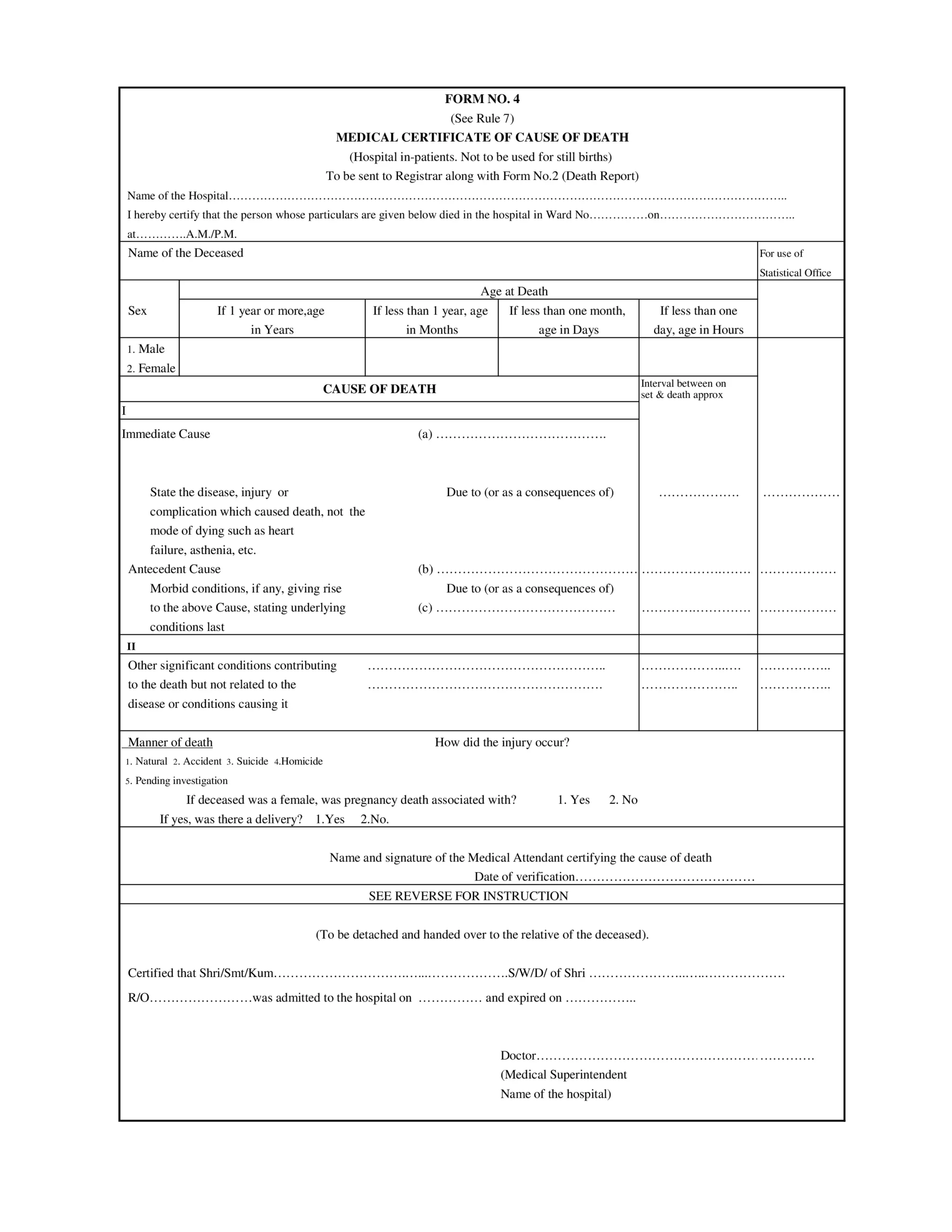
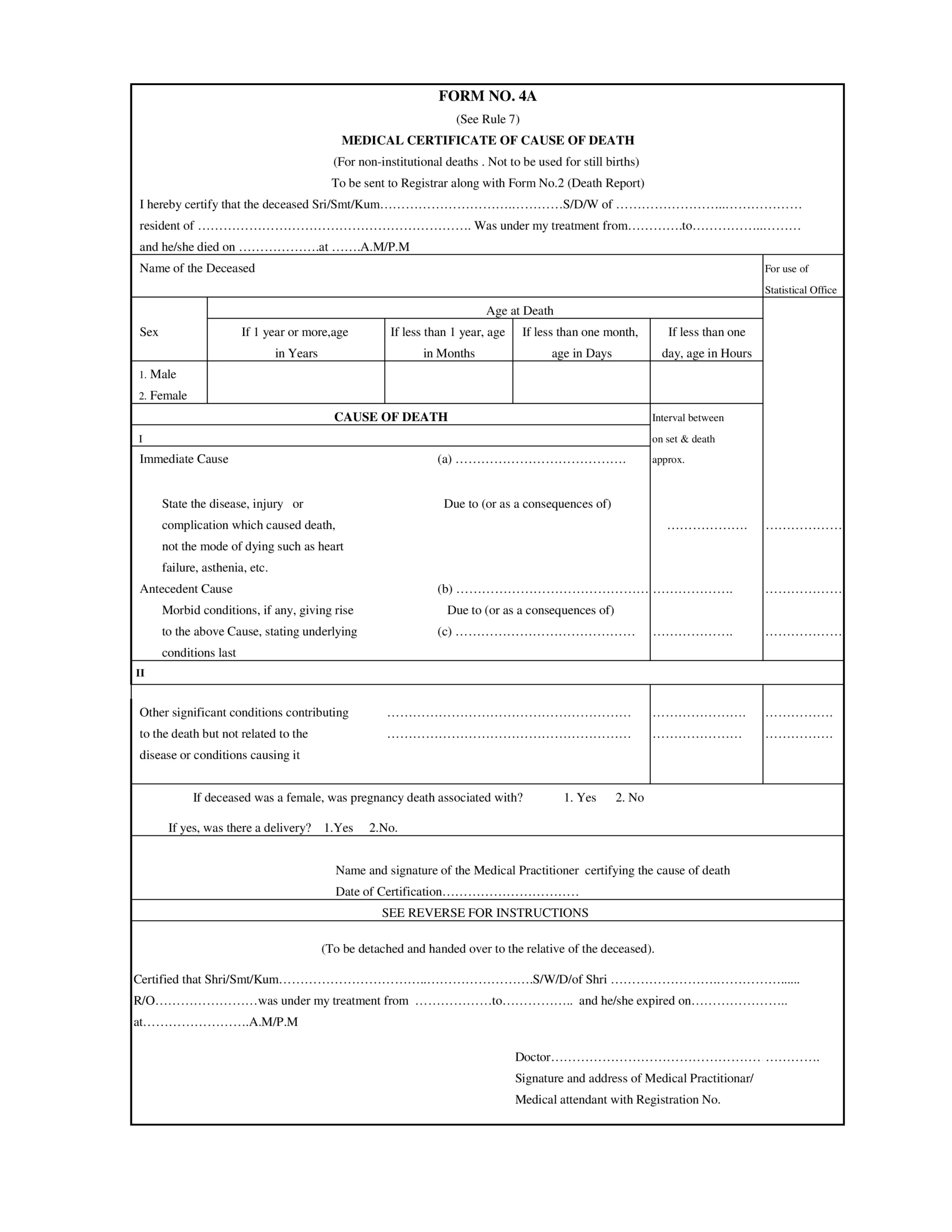
The Medical Certificate of Cause of Death is a medical document that explains the cause of death. Form 4 is issued by hospitals for deaths occurring in their wards, while Form 4A is used by family doctors or nearby clinics when a death happens at home or outside a medical institution. Both forms record the immediate and underlying cause of death. They are different from the legal death certificate issued by the municipality.
- Form 4 – Hospital deaths; completed by the attending doctor or medical superintendent.
- Form 4A – Home/community deaths; completed by the treating doctor or family physician.
- No fee – Doctors must issue the MCCD free of charge under Section 10(3) of the RBD Act.
- The MCCD is necessary to register the death and obtain permission for cremation or burial.
MCCD vs. Death Certificate
Many families confuse the doctor’s certificate with the civil death certificate. Use this table to see the difference at a glance.
| Feature | MCCD (Form 4 / 4A) | Death Certificate (Form 10) |
|---|---|---|
| Nature of document | Medical document issued by a doctor stating the medical cause of death. | Legal document issued by municipal corporation/Gram Panchayat confirming death. |
| Who issues it | Registered medical practitioner who treated the deceased. | Registrar of Births & Deaths after receiving death report and MCCD. |
| Purpose | To confirm death medically and allow death registration/cremation permissions. | To provide a legal certificate for bank, insurance, and property matters. |
| Contains cause of death? | Yes – immediate, antecedent, and contributing conditions. | No – cause of death is legally confidential and not disclosed here. |
| Fee | Free – doctors must not charge or withhold it for unpaid bills. | Usually free or nominal charges for multiple copies. |
Form 4 vs. Form 4A
Both forms follow the World Health Organization format, but they apply to different settings. Use this table to choose the correct certificate.
| Feature | Form 4 | Form 4A |
|---|---|---|
| Used for | Deaths in hospitals or other medical institutions | Deaths outside hospitals (home, road, etc.) |
| Issuer | Medical superintendent or attending doctor at the hospital | Family/treating doctor or a doctor at a nearby clinic/hospital |
| Typical scenarios | In‑patient deaths, death after surgery, deaths during a hospital stay | Natural deaths at home, deaths during home palliative care, sudden natural deaths in the community |
| Stillbirths? | Not to be used for stillbirths | Not to be used for stillbirths |
| Private practitioners | Usually not involved (hospital authorities handle it) | Frequently used by private doctors or local practitioners |
Where to get the forms
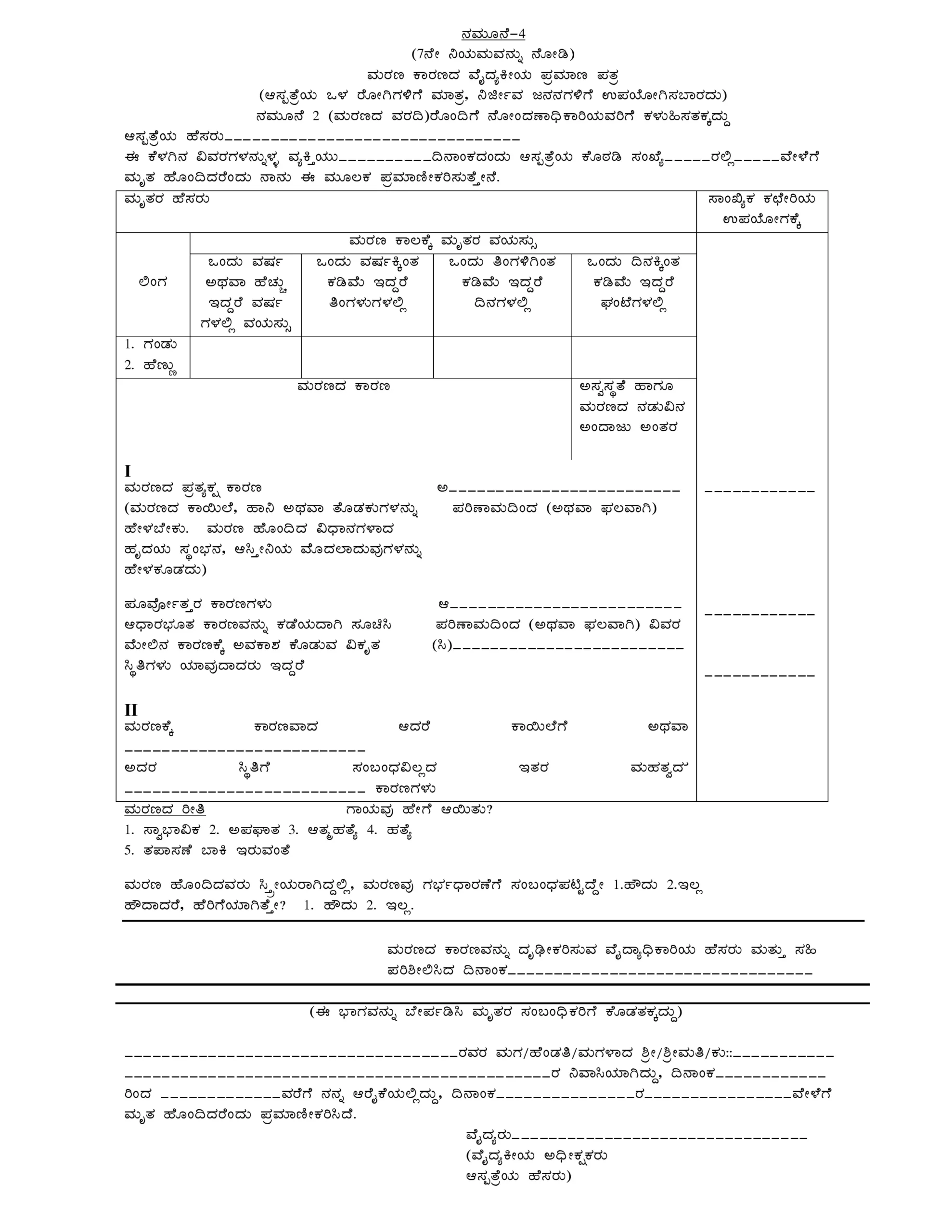
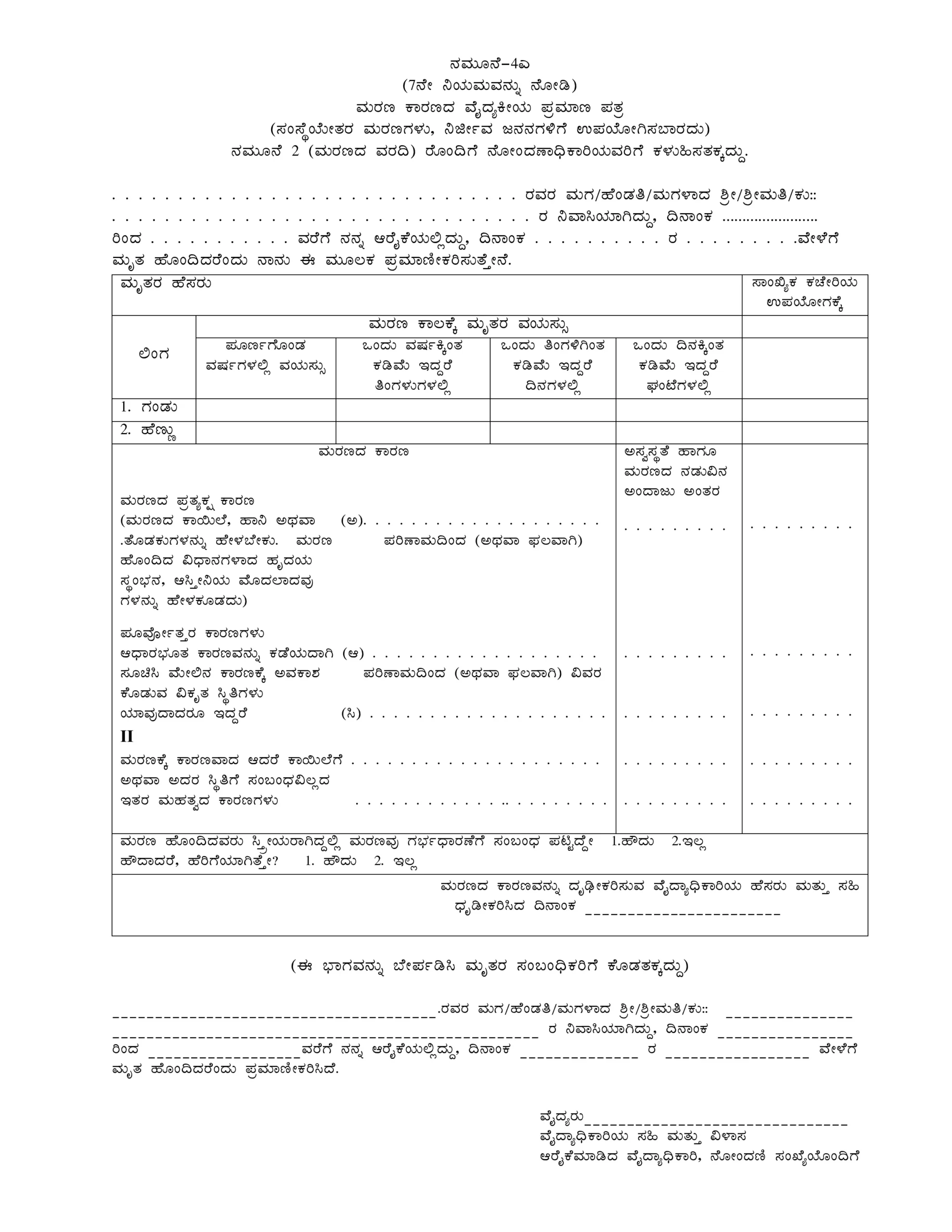
You can download official bilingual versions of Form 4 and Form 4A from the links below. Always use government‑approved templates and ensure the doctor fills in all sections correctly.
What Is the Medical Certificate of Cause of Death (MCCD)?
A Medical Certificate of Cause of Death is a medical record completed by a doctor that confirms that a person has died and explains why. It is different from the civil death certificate issued by the registrar. The MCCD records the date and time of death and lists the immediate and underlying causes of death. In contrast, the death certificate issued by the municipal corporation or Gram Panchayat is a legal document used for bank, insurance and property matters. You typically need both documents to complete final rites and settle affairs.
Legal basis
The Registration of Births and Deaths (RBD) Act empowers state governments to require a certificate of cause of death. Section 10(3) of the Act states that when a person dies under the care of a medical practitioner, the doctor must issue a certificate stating the cause of death without charging any fee. Forms 4 and 4A are standardized across India and conform to World Health Organization formats.
Why the MCCD matters
- It contributes to national mortality statistics and helps monitor disease trends.
- It legally protects families when they register the death, arrange cremation or burial, claim insurance and settle property matters.
- It confirms that a doctor has examined the deceased and determined that the death is natural; if circumstances are unclear or suspicious, the case must be referred to the police for a post‑mortem.
When Is an MCCD Required?
Natural deaths under medical care
An MCCD is mandatory whenever a death occurs under the care of a doctor. Any registered medical practitioner who attended the person during their last illness must certify the cause of death and deliver the certificate immediately. Doctors should issue the certificate only when the death is due to natural causes and they are confident about the cause.
Deaths at home (non‑hospital deaths)
For non‑institutional deaths, families should contact the treating or family doctor as soon as possible. If the doctor has seen the patient during their recent illness and is satisfied that the death is natural, they should issue Form 4A free of charge. When the family doctor is unavailable, the practical route is to take the deceased to the nearest clinic or hospital, where a doctor will confirm death. Many hospitals record such cases as “brought dead”; if the death is clearly natural and there is sufficient medical history, a doctor may still issue Form 4A.
Medico‑legal or suspicious deaths
Doctors must not issue an MCCD if the death is sudden, unexplained or suspicious (for example, in accidents, poisoning or suicide). In such cases the doctor should state that the cause of death will be determined by post‑mortem and inform the police. The body must not be cremated or buried until the investigation is complete.
What Information Is Required in Form 4/4A?
Both forms follow a similar structure. Ensure the doctor includes the following details:
- Name, age and sex of the deceased.
- Address, date and time of death.
- Immediate cause of death, antecedent causes and other significant conditions.
- Interval between onset and death – approximate duration between the onset of each condition and death.
- Manner of death – natural, accident, suicide, homicide or pending investigation.
- Pregnancy and delivery questions for women of child‑bearing age.
- Doctor’s details – name, signature, address and medical registration number.
Doctors should avoid writing modes of dying such as “cardiorespiratory arrest”. Instead they must specify the underlying disease or injury, e.g., “Acute myocardial infarction due to long‑standing hypertension and diabetes mellitus”. Write medical terms in full and one condition per line.
Step‑by‑Step Guide for Families
As funeral advisors, we at Swargayatraa have guided hundreds of families through the MCCD process. Follow these steps calmly when a death occurs at home or outside hospital.
1. Notify Close Family and Keep Calm
Inform immediate family members and have one trusted person stay with you. Avoid panicking or moving the body unnecessarily. Note the time you noticed the person unresponsive.
2. Call the Treating/Family Doctor or Nearest Hospital
Contact the doctor who has been attending the person’s illness. Ask them to come and confirm death. If unavailable, call a nearby clinic or hospital, emergency services (108) or Swargayatraa’s helpline. We can arrange transport and connect you with a doctor.
3. Request the MCCD (Form 4/4A)
After confirmation, ask for the MCCD. Specify that you need Form 4 for hospital deaths or Form 4A for home or community deaths. Ensure the doctor fills in correct names, dates and the exact cause of death. Remind them that the certificate is free and cannot be withheld over unpaid bills.
4. Verify Details Immediately
Check the form carefully before leaving the doctor’s clinic or hospital. Confirm spellings, date and time, cause of death and that the doctor’s registration number is present. Mistakes can lead to delays when registering the death.
5. Register the Death Within 21 Days
Under the RBD Act, you must report a death within 21 days. Visit your municipal office or Gram Panchayat with the MCCD, filled death report form, identity proofs and any hospital papers. If reported on time, the death certificate is usually issued within a week. You can obtain multiple certified copies for a small fee.
6. Collect Copies of the Death Certificate and Plan Final Rites
Obtain at least five certified copies of the death certificate for bank, pension, insurance and property matters. Contact your priest or community leader for last rites. If you need help with hearse vans, freezer box rentals or cremation booking, Swargayatraa can coordinate these services.
Mistakes to Avoid
- Listing the mode of dying instead of the cause: “Cardiac arrest” or “respiratory failure” are modes of dying, not causes. Doctors must write the disease or injury that led to the arrest.
- Using vague or abbreviated terms: Avoid abbreviations like “CVA” or “MI”. Write full medical terms.
- Skipping antecedent conditions: The chain of events leading to death must be recorded in sequence.
- Doctors issuing MCCD without recent involvement: A practitioner who has not attended the patient during their last illness should not issue the certificate.
- Withholding the certificate for unpaid bills: The MCCD is legally free and cannot be held back over money.
- Not reporting medico‑legal cases: Suspicious or accidental deaths must be reported to the police and handled through post‑mortem procedures.
Expert Insights and Case Examples
Timely MCCD prevents legal hassles
Mr Kumar’s father, who had been under treatment for long‑standing hypertension and diabetes, passed away peacefully at home in Bengaluru. The family doctor visited within an hour, confirmed the death and issued Form 4A with the cause written as “Acute myocardial infarction due to long‑standing hypertension”. Mr Kumar registered the death within 21 days and obtained the civil death certificate without any questions. Because the cause was clearly documented, the insurance company processed the claim smoothly and the bank closed his father’s accounts promptly.
Missing details lead to delays
Mrs Sharma’s husband passed away at home after a brief fever. She contacted a nearby doctor who wrote “cardiorespiratory failure” on a plain letterhead. When she went to the municipal office, the registrar rejected the document because it did not follow Form 4A and lacked the doctor’s registration number. The family had to revisit the doctor and request a proper MCCD. Meanwhile, the insurance company refused to accept the claim because the medical cause was unclear.
Suspicious death handled as medico‑legal
A 50‑year‑old man collapsed at a construction site. Co‑workers took him to the nearest hospital, where he was declared brought dead. The attending doctor could not determine whether the death was due to a heart attack or a fall from the scaffolding. As per guidelines, the doctor did not issue an MCCD, wrote “Pending investigation” and informed the police. A post‑mortem revealed a skull fracture as the primary cause of death. The hospital and family avoided legal complications because they followed medico‑legal procedure.
Frequently Asked Questions
Q: Is MCCD required for cremation?
Yes. For cremation or burial, municipal authorities require proof that a doctor has certified the death and identified the cause. The detachable portion of Form 4/4A serves as a permission slip for the cremation ground.
Q: Can a family doctor refuse to issue MCCD?
A doctor who attended the patient during the last illness is legally obligated to issue the MCCD immediately and free of charge. They can refuse only if the death is suspicious, unexplained or outside their competence, in which case they must refer the case for post‑mortem and inform the police.
Q: How long does it take to get the civil death certificate?
If you register the death within 21 days, the registrar usually issues the certificate within a few working days. Many municipal offices now provide digital certificates on the same day or within a week. Delays are longer if the death is reported late or if the MCCD is incomplete.
Q: What if the doctor writes “cardiac arrest” on the certificate?
Ask the doctor to specify the underlying disease or injury that caused the arrest. “Cardiac arrest” is a mode of dying and should not appear alone on the certificate. An incomplete MCCD can lead to rejection at the registration office.
Visual Guide: MCCD Forms
Below you can view the government forms. Click the image to open a high‑resolution version in a new tab.
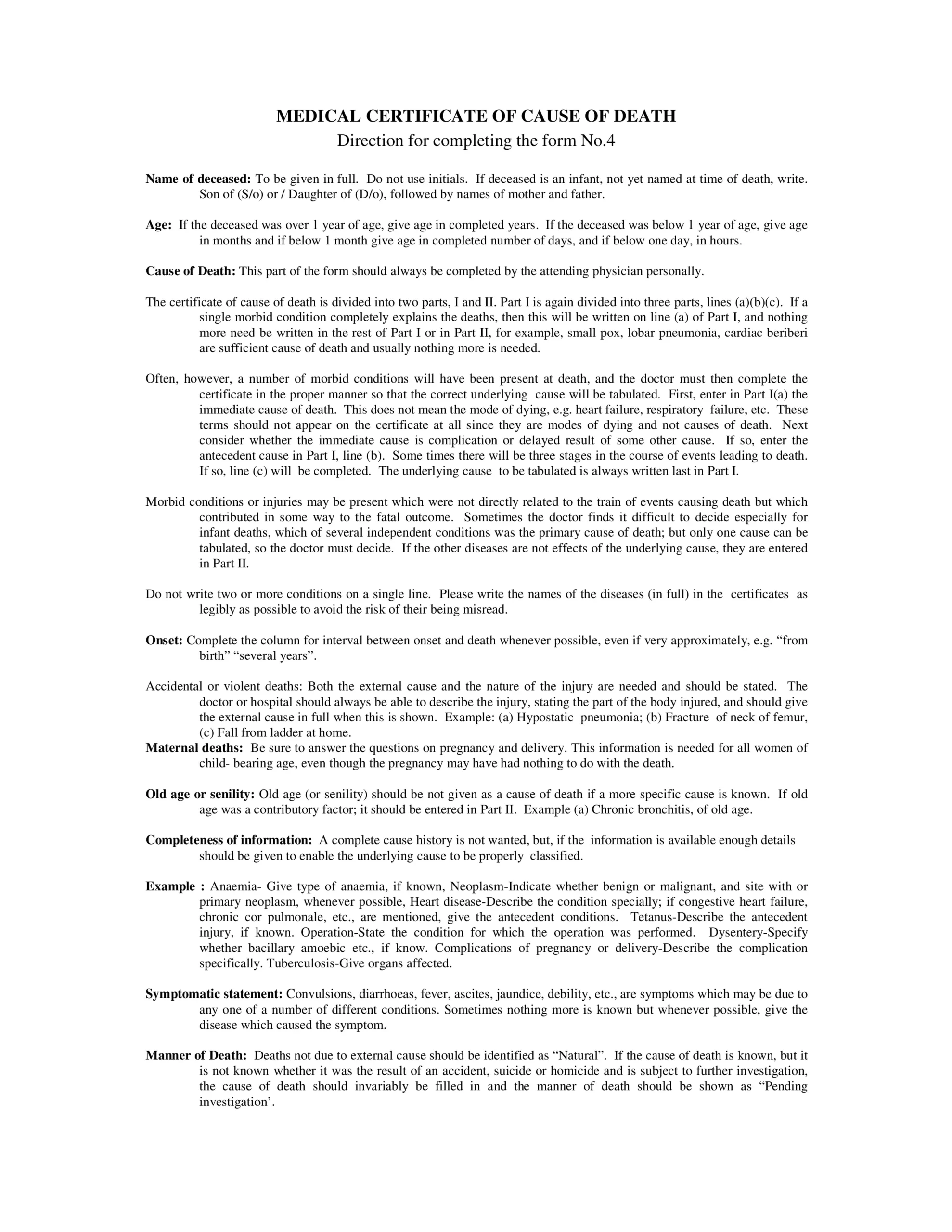
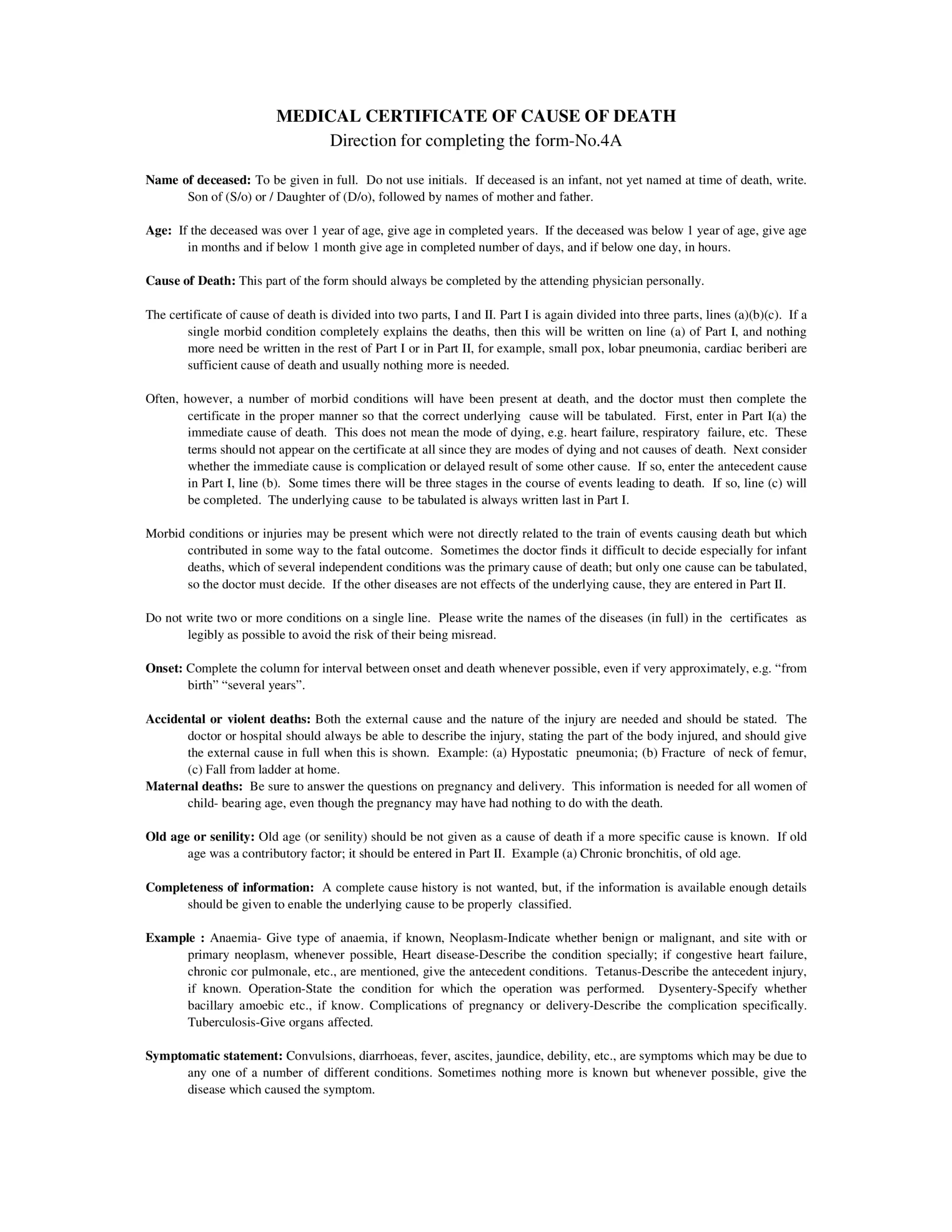
Official Guidelines: How to Fill Form 4 and Form 4A
The Registrar General of India publishes detailed instructions on how to complete Forms 4 and 4A. These guidelines explain the correct way to list causes of death, record the interval between conditions and avoid common mistakes. Downloadable copies of the guidelines are linked below for your reference.
Need Assistance With MCCD or Funeral Arrangements?
Navigating paperwork after a loss can be overwhelming. Our compassionate team in Bengaluru guides you through every step — from obtaining the correct MCCD to arranging cremation, coffin packing and transportation. We coordinate with doctors, hospitals and municipal offices so you can focus on your family.