When Is a Death Treated as a Medico-Legal Case (MLC) in India?
What to do after a natural death, a hospital “brought dead” declaration, an accident or an unexplained death. Includes BNSS Section 194, post-mortem decisions and body-release paperwork.
If the person is unresponsive and death has not been confirmed, call 112 or seek emergency medical help immediately. Do not delay treatment or avoid a hospital casualty department because of concern about an MLC. Government emergency service.
Choose your situation
Read one path first. The detailed law and documents are below.
A person with a known illness has died at home
Who to contact, what records to gather and when Form 4A may apply.
See home-death steps Path B · Hospital casualtyThe hospital says “Brought Dead” or “MLC”
What to ask the casualty doctor and how prior treatment records can help.
See hospital steps Path C · Sudden / suspected unnatural deathThere was an accident, injury or unexplained death
Police intimation, inquest, possible autopsy and formal body release.
See police-process stepsThese situations guide your next contact. They do not diagnose cause of death or determine the legal status of an individual case.
What to do after an expected natural death at home
When a person receiving treatment for a known illness dies at home, the first question is whether a treating medical practitioner can establish and medically certify the cause of death. An expected death is not automatically an MLC, but the circumstances still matter.
Contact the treating doctor
Explain when the person was last seen, the illness being treated and what happened. If death is not confirmed, seek emergency medical assistance. If the cause is uncertain, the doctor may be unable to certify it.
Keep the recent medical record ready
Gather prescriptions, discharge summaries, diagnostic records, the treating doctor's details and identification records. These help the clinician understand the course of illness; they are not proof by themselves of a natural cause.
Ask which certificate or intimation applies
Form 4A is the cause-of-death form for eligible non-institutional deaths attended during the last illness. If the doctor cannot determine the cause, ask the appropriate medical or local authority what to do next. Do not seek an unsupported certificate from an unrelated practitioner.
Arrange transport only after the required clearance
Confirm what the local crematorium, burial ground and registrar require. Where an inquiry or police hold is involved, wait for formal release before moving the body or fixing a funeral time.
Do not use age alone as evidence of natural death
A death that looks peaceful may still have an unexplained or injury-related cause. Sudden collapse, poisoning concerns, injuries, violence or contradictory circumstances require appropriate medical and possibly police assessment.

For the broader sequence from a home death to registration, see Swargayatraa's death-at-home guide.
The hospital marked the case “Brought Dead” or “MLC”. What next?
“Brought dead” describes the condition at arrival. It is not, by itself, a nationwide statutory finding that the death was unnatural or that a post-mortem is compulsory. Hospitals assess such cases under their medical and medico-legal procedures.
Ask the casualty medical officer for the present case status
Was the person recorded as brought dead? Has an MLC been registered? Has police intimation already been sent? Ask which department is authorised to issue the next instruction.
Show records of the illness and previous care
Share OPD consultations, recent admission summaries, medication history and the treating specialist's name. Ask whether the doctor can certify a medically supported cause of death or whether further inquiry is required.
If the police are involved, ask who is handling the inquiry
Record the police station, officer's name and case reference if provided. Give accurate information about the events before arrival. Never alter records or ask for an inaccurate natural-death certification.
Confirm the release authority and the expected next update
Ask whether medical examination is ordered, where the body is being held, what identification the claimant needs and who will communicate the release decision. Avoid promising relatives a funeral start time before this is confirmed.
Can an autopsy be avoided when there is a known terminal illness?
Prior treatment records may help the doctor and investigating authority assess the circumstances, but the family cannot demand an exemption under BNSS Section 194(3). That provision sets out circumstances requiring forwarding for medical examination, subject to applicable law. Decisions depend on the facts, medical assessment and lawful directions.
What happens after an accident, suspected suicide, violence or an unexplained death?
Where death follows an accident, suspected self-harm, violence, poisoning or circumstances suggesting an offence, police procedures may be required. An apparently natural death after hospital admission may still remain medico-legal if an earlier injury contributed to it.
Get emergency help and report the circumstances
If there may still be life, call 112. For a suspected unnatural death, contact the local police or emergency response service. Do not interfere with possible evidence or move the body unless necessary for immediate safety or medical care.
Police assess whether an inquest is required
The investigating officer follows the applicable procedure, may examine the scene and body, speak with witnesses and prepare a report of the apparent cause of death under BNSS Section 194. A local record may be described as an unnatural-death report or UDR; an FIR is not generated in every case.
Medical examination or forensic post-mortem, when ordered
The authority decides on referral to an authorised medical facility under the relevant legal and state procedures. The mortuary controls its examination schedule; no national completion time can be promised.
Receive the authorised handover before arranging final rites
Ask the investigating officer and mortuary which release document, receipt and other papers apply to that case. Keep the originals together and confirm the crematorium or burial ground's documentation requirements before departure.
In an injury-related death, tell the hospital about the original incident even if the person later died from infection, organ failure or other complications. The underlying sequence of causes matters.
Which situations can lead to a medico-legal case?
Location and age do not determine MLC status on their own. The cause, manner and circumstances of death—and the medical officer's and authorities' assessment—are decisive.
| Situation | Likely next assessment | Question to ask |
|---|---|---|
| Known illness, expected death at home | Treating clinician assesses whether a cause-of-death certificate is appropriate. | Can the attending practitioner certify the cause? |
| Inpatient death during treatment for disease | Hospital certification and handover, unless circumstances require medico-legal handling. | Has the hospital classified this as an MLC? |
| Hospital death days after an accidental fall | Earlier injury may make the death medico-legal regardless of time admitted. | Was the initial injury reported and recorded? |
| Brought dead at casualty | Medical assessment; some cases require police intimation or inquiry. | What status was recorded, and why? |
| Road accident, suspected poisoning or suicide | Police/intimation and inquest procedure may apply; examination may be ordered. | Which officer controls the inquiry and release? |
| Woman within seven years of marriage, with specified circumstances | Special BNSS requirements may apply, including Magistrate inquiry. | Which subsection governs this case? |
| Death or disappearance in authorised custody | Section 196 provides for an additional Magistrate inquiry in specified situations. | Who is conducting the required inquiry? |
Police inquest is not the same as a post-mortem
Police gather and document apparent circumstances; an authorised medical professional examines the body when required. The inquest report, medical opinion and legal decision about release serve different purposes.
From police intimation to body release
The following sequence shows the main handovers. Not every death involves every step, and an inquiry may need additional evidence or a Magistrate's directions.
Intimation
Police receive information from a hospital, family member or other source and identify the jurisdiction and the matter requiring investigation.
Police inquest and reporting
Where Section 194 applies, the officer investigates the apparent cause, documents injuries or marks and prepares the inquest report. Under Section 194(2), the signed report is forwarded to the District or Sub-Divisional Magistrate within 24 hours; that is not a body-release guarantee.
Medical examination, if required
Section 194(3) identifies cases for forwarding to an appointed qualified medical professional, subject to its conditions and relevant state rules. A forensic post-mortem may form part of the procedure.
Formal release
The hospital, mortuary and investigating authority confirm when the body may be handed over and which paperwork accompanies it. Do not assume the final post-mortem report is already available.
Transport, funeral and civil registration
Check the destination facility's entry rules, complete last rites and follow the local civil registration process. Civil death registration and an MLC investigation are separate processes.
Form 4, Form 4A and the civil death certificate: three different records
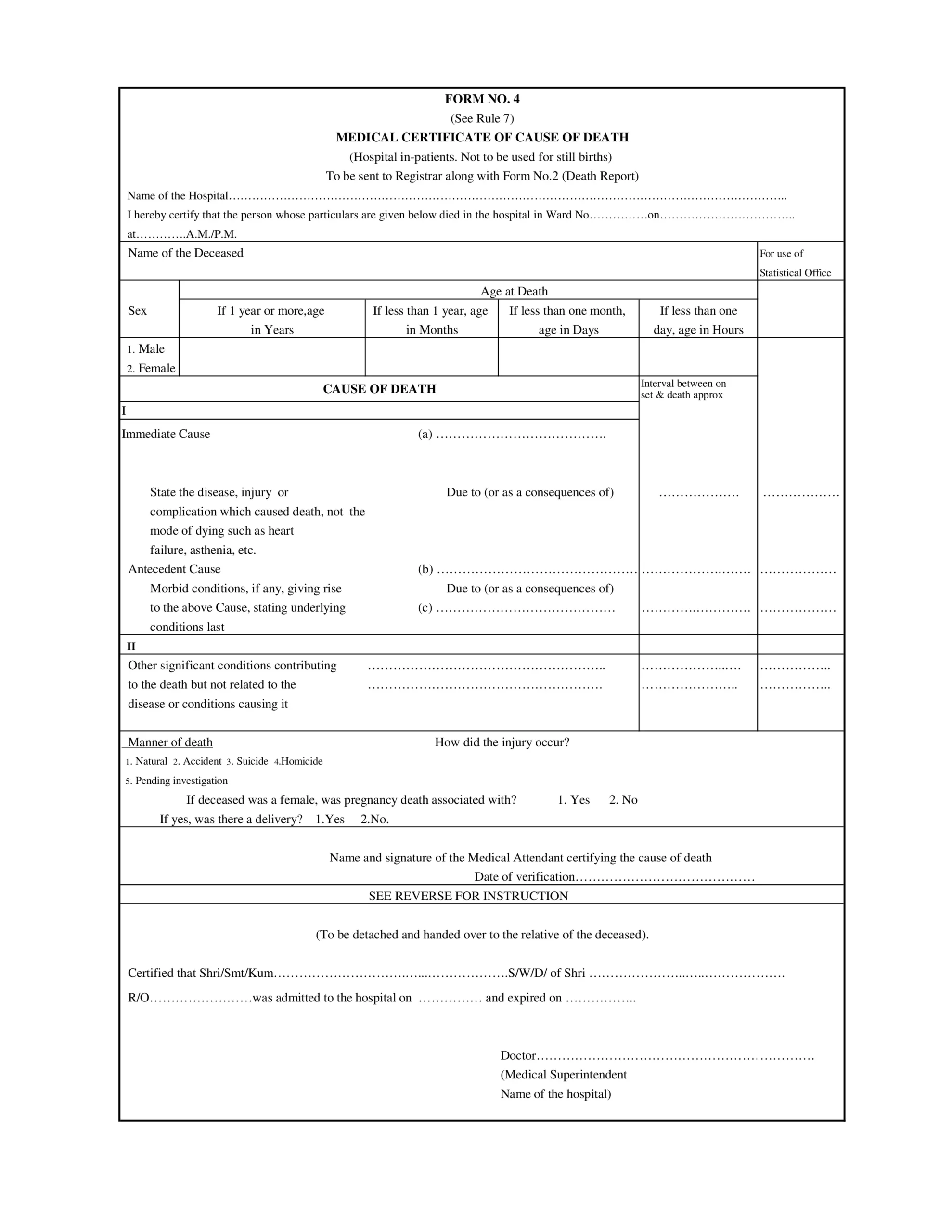
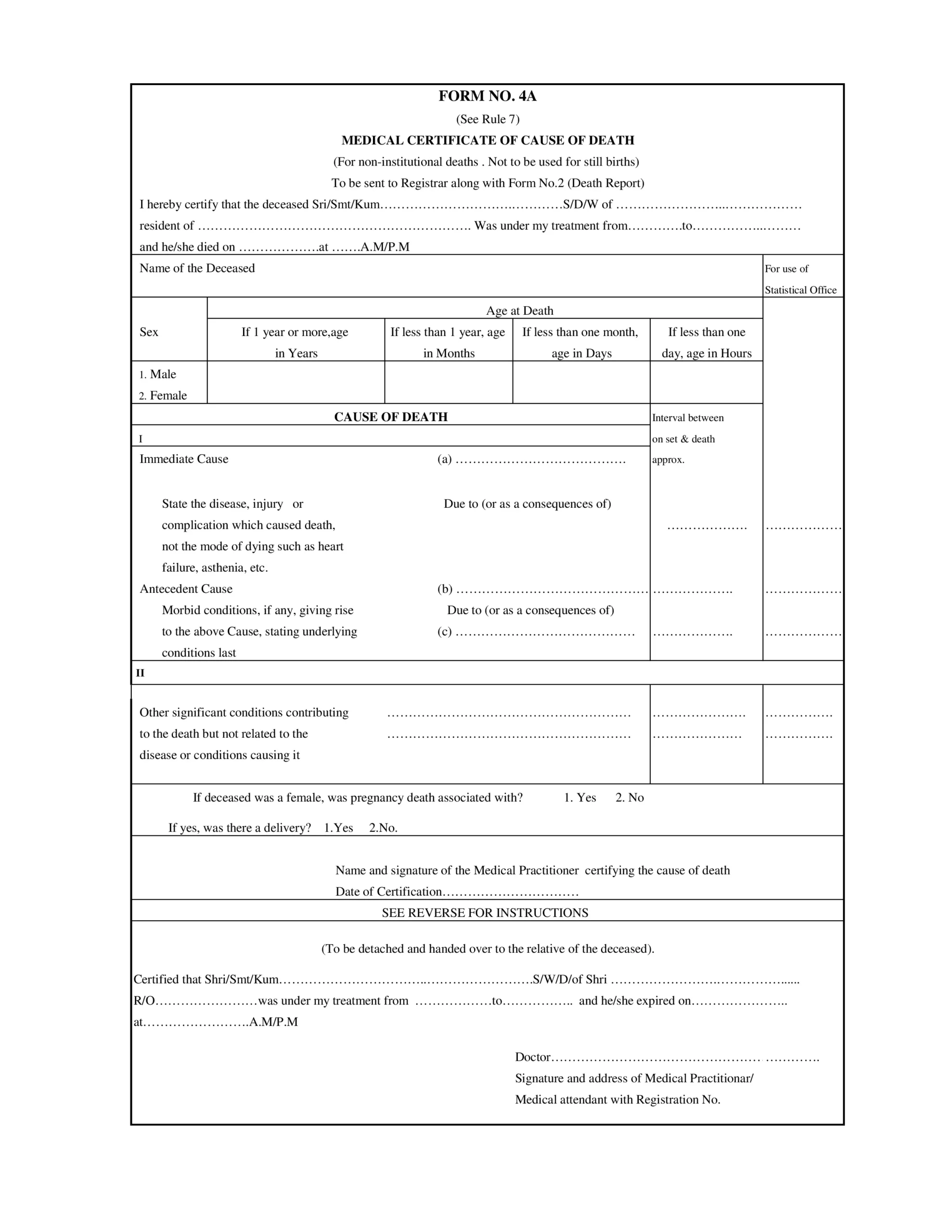
India's Medical Certification of Cause of Death (MCCD) scheme uses Form 4 for institutional deaths and Form 4A for qualifying non-institutional deaths. The Registrar's death certificate is a different document issued through civil registration.
What each document does
| Record | Purpose | Main point to check |
|---|---|---|
| MCCD Form 4 | Medical certification of cause of death in an institution. | Hospital details and the certified medical cause. |
| MCCD Form 4A | Medical certification of cause of death outside an institution, where its conditions apply. | The practitioner attended the person during the last illness. |
| Registrar-issued death certificate | Official civil record of the registered death. | Registration is distinct from medical certification. |
| Hospital or mortuary body-release record | Records handover of the body to an authorised person. | Confirm who may receive the body and when. |
“Cardiac arrest” is not necessarily a sufficient underlying cause
A medical cause-of-death certificate is meant to record the disease, injury or chain of conditions leading to death, as clinically known—not merely a terminal mechanism. Only the certifying clinician can decide what the evidence supports.
Official background: Office of the Registrar General & Census Commissioner of India — Medical Certification of Cause of Death.
Which papers are needed after an MLC or post-mortem?
There is no verified nationwide rule that every MLC family must collect the same three-document packet at every crematorium. Ask the investigating authority, mortuary and destination facility for the exact requirement.
| Paper or record | Issued / controlled by | Why it matters |
|---|---|---|
| Case reference or MLC/intimation details | Hospital and/or police | Helps staff locate the case and identify its responsible authority. |
| Inquest / UDR papers | Investigating authority | Records inquiry details; availability to family varies. |
| FIR, where one is registered | Police | May be relevant to criminal investigation or insurance; not every unnatural-death inquiry has an FIR. |
| Medical examination / post-mortem documentation | Authorised medical facility | May include a receipt, handover record or reports released later through official channels. |
| Police release permission / NOC, when required | Investigating authority | May authorise handover or funeral arrangements as applicable. |
| Claimant identification and mortuary handover receipt | Family and hospital/mortuary | Establishes who receives the body and when. |
| Crematorium or burial permit/booking acknowledgement | Local facility or civic authority | Requirements differ by location and method. |
Keep photographs or copies of papers legally provided to you, alongside the names and roles of officials who issued them. Do not assume a provisional post-mortem certificate or the complete inquest report will be handed directly to every family at the mortuary.
For road transport, domestic air cargo and documentation distinctions, see our documents after death guide.
Can a post-mortem take place after sunset in India?
Yes, at hospitals with adequate infrastructure and after the hospital assesses whether the particular case is suitable. The Union Health Ministry permitted nighttime post-mortems under its office memorandum dated 15 November 2021.
The order requires nighttime examinations to be video-recorded and preserved for legal purposes. Cases involving suspected homicide, suicide, rape, decomposed bodies or suspected foul play should ordinarily not be examined at night unless a law-and-order situation warrants it. Organ-donation cases receive priority where adequate infrastructure exists.
This is permission, not a promise of overnight availability at every mortuary. For example, the Government of India's Safdarjung Hospital describes its round-the-clock post-mortem service; another hospital may operate differently. See the hospital's official department page.
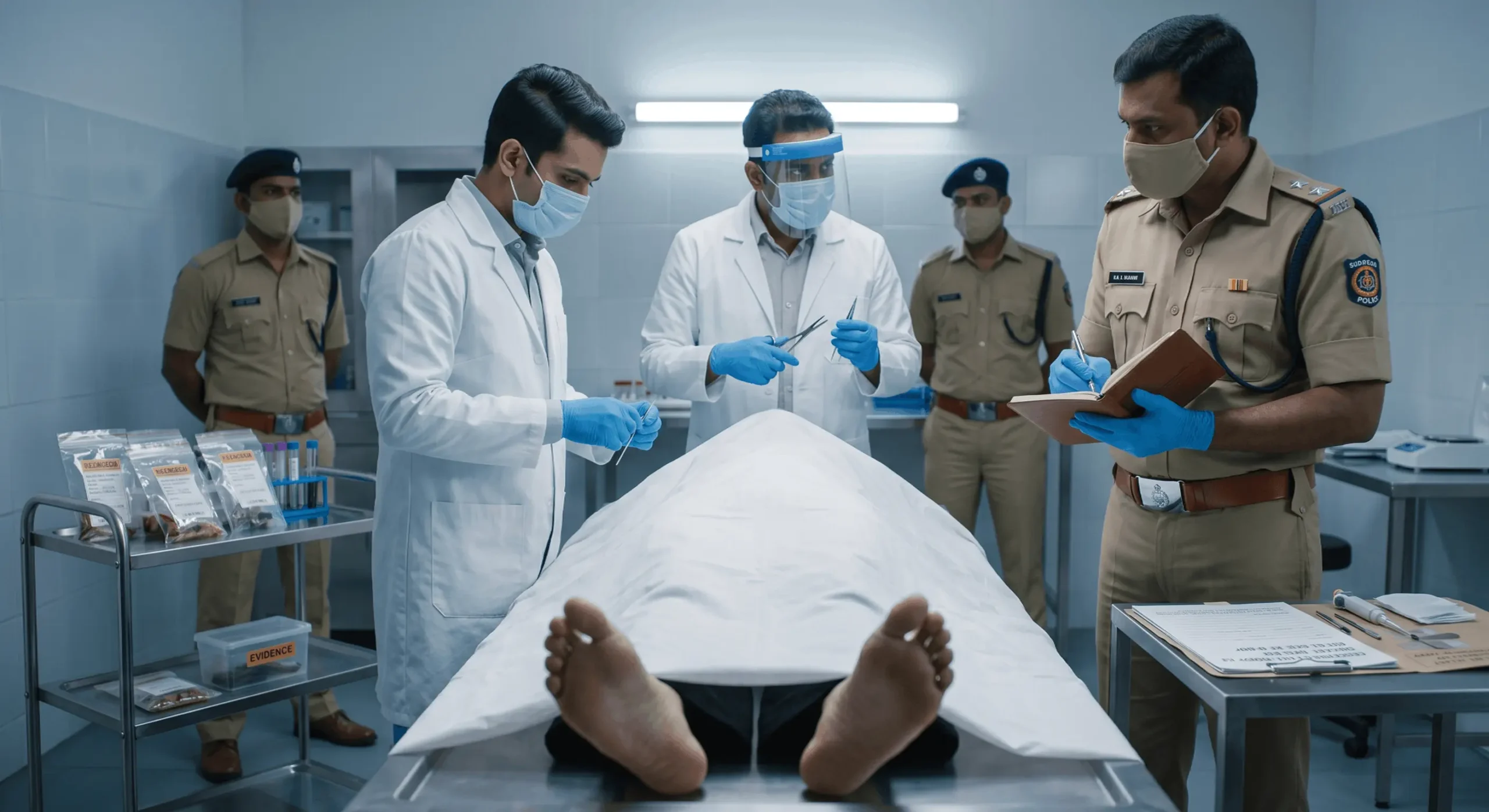
View the post-mortem reference image and image notice in the police-process section →
Questions to ask the mortuary
Has the examination been ordered? Is this case eligible for an after-sunset examination? Is the authorised team available? Who can confirm the handover stage? Only the responsible hospital and investigating authority can answer these for your case.
BNSS Sections 194 and 196 explained in plain English
The Bharatiya Nagarik Suraksha Sanhita, 2023 came into force on 1 July 2024 and replaced the Criminal Procedure Code for the corresponding new-law procedures. Section 194 broadly corresponds to the former CrPC Section 174; Section 196 covers specified Magistrate inquiries.
Section 194(1): When police conduct an inquiry
The provision covers information that a person died by suicide, was killed by another person, an animal, machinery or an accident, or died under circumstances reasonably suggesting that someone committed an offence. The empowered police officer informs the nearest Executive Magistrate and, subject to applicable directions and state rules, investigates and records the apparent cause in the presence of witnesses.
It does not say that every death occurring at home or every arrival marked “brought dead” is automatically an MLC.
Section 194(2): What must be sent within 24 hours?
The signed police report of the inquest is to be forwarded to the District Magistrate or Sub-Divisional Magistrate within 24 hours. This deadline is for sending the report. It is not a legally guaranteed time to complete an autopsy, issue a cremation NOC or release the body.
Section 194(3): Five examination-referral circumstances
Subject to its statutory conditions and relevant state rules, Section 194(3) identifies these circumstances for forwarding the body for medical examination:
- Suicide by a woman within seven years of marriage.
- Death of a woman within seven years of marriage with reasonable suspicion that another person committed an offence concerning her.
- Death of a woman within seven years of marriage where a relative requests the examination.
- Any doubt about the cause of death.
- Any other reason the police officer considers medical examination expedient.
These are not the same as five categories of deaths that automatically require both a police inquest and post-mortem in every situation. This subsection is also not a general family-requested autopsy-waiver rule.
Section 196: When does a Magistrate inquire?
Section 196(1) requires a Magistrate inquiry for the situations referenced in Section 194(3)(i) and (ii), and allows an inquiry in other relevant Section 194(1) cases. Section 196(2) sets out additional inquiry requirements for deaths, disappearances or alleged rape in specified police or judicial custody circumstances.
The authority and procedure depend on the precise statutory category. Describing all deaths within seven years of marriage as an identical non-waivable two-doctor post-mortem process would be inaccurate.
Why can state and hospital procedures differ?
The BNSS itself refers to state-prescribed rules and the decisions of competent authorities. Hospitals also have their own lawful reporting and mortuary processes. Consequently, an MLC number, report name, access to documents and method of body release cannot responsibly be described as identical at every hospital in India.
For the authoritative legislation, use the Government of India's Bureau of Police Research & Development collection of the new criminal laws.
Five checks that can prevent a second trip
- Case status: Ask whether the body remains under hospital or police control.
- Receiving person: Confirm which relative or representative can sign for handover and what ID is needed.
- Documents: Ask the issuing authority and destination crematorium which originals, copies or receipts must travel with the body.
- Time: Confirm the release stage with the responsible desk before finalising a departure or ceremony slot.
- Destination and transport: Tell the facility whether the plan involves a nearby crematorium, intercity road journey or airline cargo; requirements can differ.

What Swargayatraa can help coordinate
After the appropriate authority permits release, our team can help plan mortuary transport, a hearse, preservation when required and funeral or crematorium logistics. We do not determine MLC classification, cancel an investigation, issue Form 4A, order an autopsy or grant police clearance.
Common questions about MLC, police and post-mortem
Does every person declared brought dead need a post-mortem?
No universal rule makes an autopsy compulsory merely because the casualty sheet says “brought dead”. The hospital and competent authority assess the medical history, circumstances and applicable protocols. An unexplained or suspicious death can still require investigation.
Does a death after 24 hours in ICU become a natural death?
No. There is no blanket 24-hour admission rule that changes an injury-related or otherwise medico-legal death into a natural death. The contributing cause and earlier circumstances remain relevant.
Can the family refuse a post-mortem?
A family may express concerns and provide medical information, but cannot unilaterally cancel an examination lawfully directed by the appropriate authority. Ask the investigating officer what provision and order apply; seek qualified legal help if necessary.
Does every MLC require an FIR and police NOC?
No single paperwork route applies to every case. Police inquest records, FIR registration and body-release permissions depend on what is being investigated and on local procedures. Confirm the specific records that exist in your case.
Will the family receive the final post-mortem report on the day of examination?
Not necessarily. Reports, laboratory findings and access to forensic documents follow hospital and investigative procedures. A body may be released under competent authority's instructions without the family receiving the full final report that day.
Is police involvement compulsory whenever a person dies suddenly?
Not every sudden death follows the same procedure. The clinician must assess what can medically be certified and the circumstances may call for police intimation. Where the cause is unclear or suspicious, seek immediate guidance from the hospital or local police rather than assuming a natural death.
Can a post-mortem happen at night?
Yes, when the hospital has suitable facilities and the case meets the Health Ministry protocol. Nighttime work is not guaranteed for every case or facility. Suspected homicide, suicide, rape, decomposed bodies and suspected foul play are normally excluded except for relevant law-and-order situations.
What should we do if the release is delayed?
Ask the hospital or investigating officer which step is pending, who has the next decision, and when the family can request another update. Arrange mortuary preservation where required. Do not announce a fixed cremation time until release has been confirmed.
Official legislation, medical guidance and related reading
The central-law explanations above were checked against Government of India material. Local police orders, hospital protocols and municipal crematorium requirements still need case-specific confirmation. This is public guidance, not an individual legal or medical determination.
Sections 194 and 196, operative from 1 July 2024. Bureau of Police Research & Development, Ministry of Home Affairs.
Read the government's new criminal laws collection ↗Official background for institutional Form 4, non-institutional Form 4A and the Registration of Births and Deaths Act.
Office of the Registrar General & Census Commissioner ↗Ministry of Health and Family Welfare office memorandum H-11021/07/2021-H-I, and its government press announcement.
Read the Ministry announcement ↗Official description of medico-legal services and a hospital that has implemented round-the-clock post-mortem work.
Read the government hospital page ↗Government Emergency Response Support System for police, medical and other emergencies.
Read 112 official guidance ↗Continue with a related Swargayatraa guide
This article provides general information, not an individual medical or legal determination. Procedures depend on the facts and applicable local rules. Swargayatraa cannot issue medical or police certificates or direct an investigating authority.
